
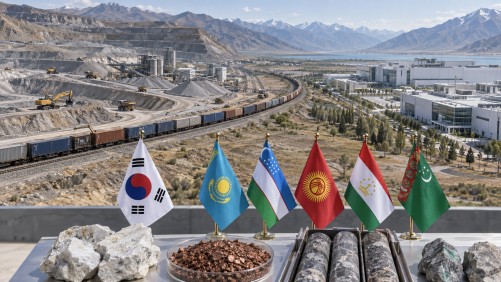
As global powers compete for access to vital resources, South Korea is intensifying its collaboration with Central Asian nations to secure critical minerals essential for its industries. This development follows the inaugural South Korea–Central Asia summit in Seoul, which laid the groundwork for a strategic alliance aimed at ensuring a stable supply chain for these materials.
At the summit, South Korea and Central Asian countries forged over 70 agreements and memorandums, demonstrating a mutual commitment to cooperation. The summit, set to occur biennially, also led to the creation of a C5+1 forum where industry ministers can engage in dialogue. The focus is on critical minerals, which are crucial for South Korea’s automotive, electronics, battery, and energy sectors, as well as on assisting Central Asian countries to enhance their processing capabilities beyond the mere export of raw materials.
In a bid to harness the synergy between South Korea’s expertise in exploration and advanced manufacturing and Central Asia’s abundant mineral reserves, both sides have proposed initiatives covering the full spectrum of the supply chain. This includes the identification of deposits, mining, processing, and the production of high-value products. South Korea is also investing in rare metals research and training facilities in the region to bolster this cooperation.
Within this framework, Uzbekistan has put forward the idea of forming an investment alliance to foster critical mineral development and processing clusters. Meanwhile, Kazakhstan has extended offers of collaboration in areas such as rare metals, nuclear and clean energy, artificial intelligence, and infrastructure, while looking to deepen its strategic relationship with South Korea.
Other Central Asian nations, such as Kyrgyzstan and Tajikistan, are exploring partnerships with South Korea in the mining of minerals like antimony and tungsten. Additionally, South Korea is increasing its involvement in transport and infrastructure projects across the region, signaling a broadening of its economic footprint.
This burgeoning partnership comes amid heightened interest from global players like China, the United States, the European Union, and Japan, all of whom are eager to tap into Central Asia’s critical mineral resources. As these countries vie for influence, Central Asian governments are intent on attracting investments that would facilitate local processing and industrial production, rather than simply exporting raw materials.
The next South Korea–Central Asia summit is slated to be hosted by Kazakhstan in 2028, offering another opportunity to strengthen these emerging ties.