
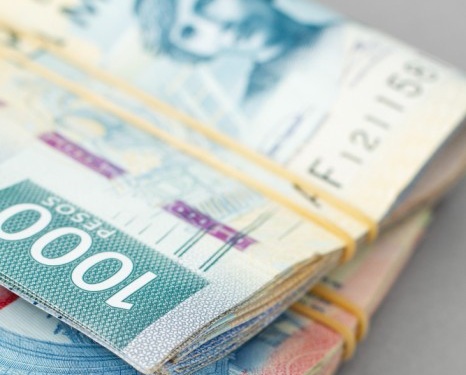
On Monday, the Philippine peso reached a new all-time low as it depreciated by 2.9 centavos to P61.75 against the US dollar, surpassing the previous record of P61.721 set on Friday. This decline was accompanied by a slump in the stock market, where the Philippine Stock Market index (PSEi) fell by 35.25 points, or 0.59 percent, closing at 5,941.52. Market participants have become increasingly sensitive to both global and domestic uncertainties, contributing to the peso’s weakness.
A trader noted that the peso’s recent movements have been influenced more by market sentiment than by fundamental economic factors. While the US dollar remains strong, the decline in the peso also reflects heightened demand for safe assets, increased dollar purchases related to oil, and a growing sensitivity to domestic uncertainty. The trader highlighted that positioning and momentum are also significant at current levels, as they can accentuate market moves in conditions of limited liquidity.
The peso’s near-term outlook suggests a continued downward bias, with the psychological barrier of P62:$1 seeming closer, though significant fluctuations in either direction are expected. The peso joined the ranks of other Asian currencies such as the Indonesian rupiah and the Indian rupee, which also plummeted to record lows. Renewed tensions in the Gulf region have pushed oil prices and global yields higher, bolstering the US dollar and exerting pressure on economies dependent on oil imports.
The rupiah, a currency struggling in the region, suffered a 1.16 percent drop to 17,665 per dollar, marking its largest intraday percentage loss since April 2025. Meanwhile, the Indian rupee hit a historic low of 96.303 per dollar, continuing its downward trend that intensified after the Iran conflict drove oil prices up in late February. MUFG analyst Michael Wan pointed out that Asian emerging market currencies are being hit hard by the stronger dollar, with the rupee and the peso particularly affected by rising oil prices, while the rupiah faces additional domestic challenges.
According to Japhet Tantiangco, research manager at Philstocks Financial Inc., concerns about the Middle East conflict have resurfaced, fueled by recent threats from Trump towards Iran, prompting investors to adopt a defensive stance. Luis Limlingan, head of sales at Regina Capital Development Corp., mentioned that buying interest remains subdued as investors wait for more definitive market catalysts. The ongoing weakness of the peso and rising global crude oil prices further dampened sentiment. Trading activity was lackluster, with net value turnover dropping to P3.85 billion, significantly below the year-to-date average, indicating continued investor hesitation. Foreign funds also remained cautious, resulting in net outflows of P225.76 million. Among the sectors, only property stocks ended in positive territory with a slight gain of 0.19 percent, while the mining and oil sector led the decline with a 3.4 percent drop. Market breadth was negative, featuring 117 decliners compared to 65 advancers, and 68 issues remained unchanged.