
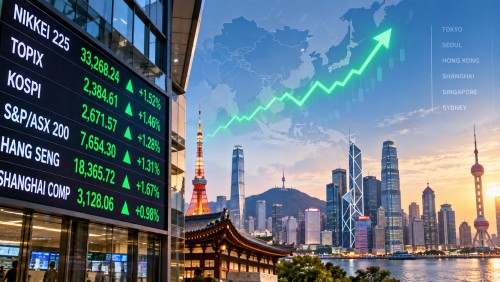
Asian stock markets closed mostly higher on Friday, buoyed by a strong performance on Wall Street and a dip in oil prices. This development comes as global financial markets continue to adjust to recent monetary policy changes and economic indicators.
In particular, Japan’s Nikkei 225 saw an increase of 0.8% in early trading, while South Korea’s Kospi surged by 2.1%. Hong Kong’s Hang Seng Index and the Shanghai Composite each rose nearly 0.8%, reflecting broader regional optimism. Australia’s S&P/ASX 200 experienced a modest gain of 0.1%.
These gains mirrored the upward momentum on Wall Street, where the S&P 500 advanced by 1.1%, the Dow Jones Industrial Average grew by 0.6%, and the Nasdaq Composite climbed by 1.7% in the previous session. The positive sentiment was partly attributed to a decline in oil prices, with Brent crude falling 0.68% to $104.11 per barrel and U.S. crude decreasing 0.54% to $101.36 per barrel, alleviating some pressure on financial markets.
Investors also responded to the Federal Reserve’s recent decision to raise its benchmark interest rate by 0.25 percentage points. The Fed hinted at the possibility of another rate hike later in the year as part of its ongoing efforts to combat inflation and achieve a 2% target. In response, the yield on the 10-year U.S. Treasury note decreased to 4.93% from 5.01%, further reducing pressure on equities.
In currency markets, the U.S. dollar showed slight strengthening against the Japanese yen, reaching 156.15 yen, while the euro remained stable at $1.1480. These movements reflect the complexities and interconnections of global economic conditions as markets adapt to new financial landscapes.